The Notre Dame-Navy Game and the College Football Playoffoff
Notre Dame-Navy must endure playoff expansion, preserving college football’s underdog spirit, rich traditions and unique travel experiences for fans.

Schools in this article


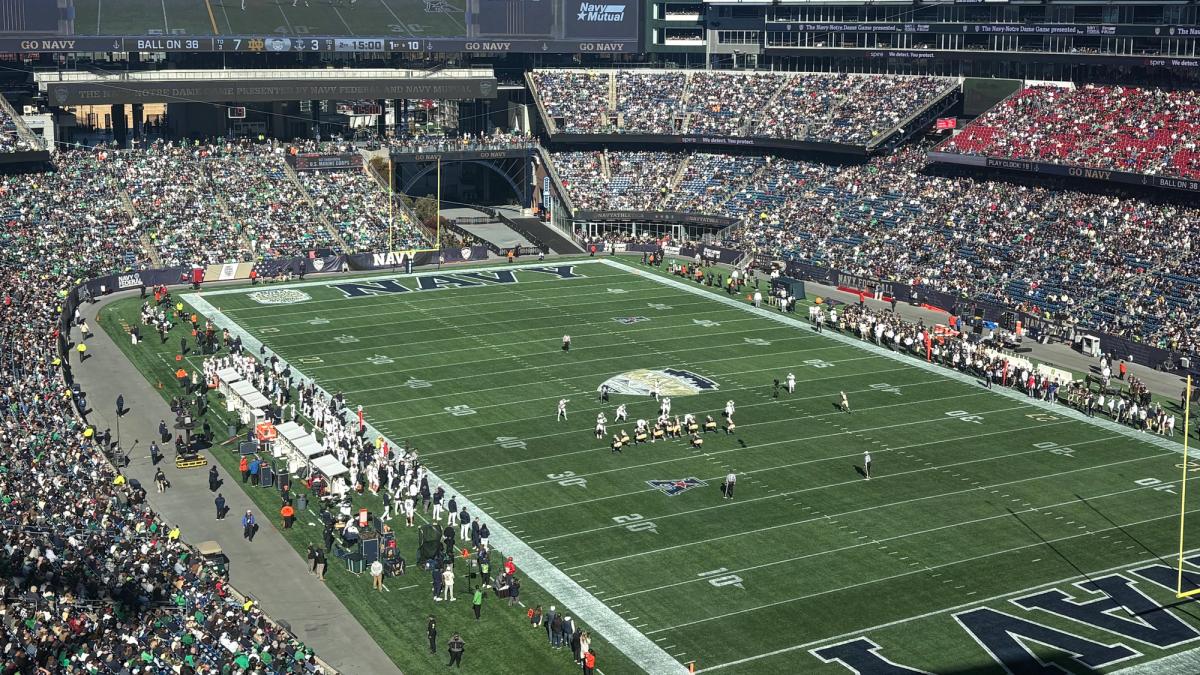
Between Navy’s first-half upset bid against Notre Dame and the scenes around Boston surrounding Saturday’s Notre Dame-Navy game, one thing became clear.
Notre Dame-Navy must survive in the 24-team College Football Playoff landscape.
On the eve of the game, scores of Irish and Midshipmen fans dotted downtown Boston. The fan bases took over Beantown and gave the game an unmistakable presence.
The Notre Dame-Navy game is a biennial bowl game. Navy has never hosted the Irish on campus, so it gives both fan bases an extra visit to an NFL stadium and a big city. The novelty of this game grows as most of the Power Four’s bowl inventory is in jeopardy with the College Football Playoff’s expansion.
College football’s whimsicality for fans is a unique aspect of the sport. The sport’s postseason has centered around tourism for over a century. Notre Dame-Navy keeps that tradition alive during the regular season. Since 2016, Notre Dame and Navy fans have experienced Jacksonville, San Diego, Baltimore, Dublin, New York City, and Boston.
Simply put, fans need fun experiences, and not just the churn of a Playoff push that runs through the same six bowls.
In theory, the College Football Playoff’s expansion should encourage games like Notre Dame-Navy. There is more room for error in the regular season than ever now, so Power Four teams can get out of their comfort zone and schedule neutral site games with Group of Six schools. These games can practically replace bowl games if most Power Four bowl opportunities vanish with Playoff expansion.
Perhaps more importantly, Saturday’s Notre Dame-Navy game showed the value of the underdog in college football. Navy entered at 2-6, a team stripped of the foundations of its 21-5 run over the last two years. They faced a Notre Dame team ranked 5th in the country with only a loss to BYU.
Nonetheless, Navy had the country on the edge of its seats and monitoring the score for a full half. The Midshipmen played keep-away and nearly took a 13-7 lead to halftime. Although, Notre Dame eventually prevailed 35-13, the game reminded many of college football’s crown jewel: underdogs.
Talks of a separate Group of Six Playoff have accompanied 24-team College Football Playoff expansion discourse. This combines with less regular-season overlap between the Power Four and Group of Six. All Power Four teams will play 10 Power Four opponents beginning next year.
This diminishing overlap and growing competitive disparity make monumental upset bids rarer. The Group of Six is notably 3-74 against the Power Four this year. Yet, Navy reminded many of the wonder of an upset. On paper, Navy had no chance of competing with the Irish, yet they did for a full half.
Many figures in the Power Four, decision makers and fans alike, want nothing to do with the Group of Six. Nevertheless, college football’s vast landscape and competitive range across each division make it distinct from the NFL.
Navy’s upset bid against Notre Dame was enthralling because of the obstacles Navy faces in the NIL era and the history working against them. Fewer games like this hurt the sport. Narrowing the landscape of college football with less Group of Six/Power Four crossover makes the sport a mere NFL imitation.
Notre Dame-Navy may not be the most intense rivalry or even the most well-known one. However, it remains a beacon in a changing college football landscape. The rivalry showcases college football’s vastness and encourages the tourism that makes college football unrivaled.